
#175: Short Takes: Revolut built its own growth algorithm to compete with other neobanks; why Visa and Mastercard are cutting jobs to fund AI agents
W FINTECHS NEWSLETTTER #175
👀 Portuguese Version 👉 here
👉 W Fintechs is a newsletter focused on financial innovation. Every Monday, at 8:21 a.m. (Brasília time), you will receive an in-depth analysis in your email.

Welcome to the Short Takes edition! As the name suggests, unlike deep dives, these editions will explore a variety of topics that might later evolve into full deep-dive editions.
Short Takes is designed for entrepreneurs, investors, and operators looking for quick, actionable insights.

Revolut’s growth algorithm is still not slowing down
Revolut closed 2025 with £4.5 billion in revenue, representing 46% year-over-year growth, or 57% in U.S. dollar terms, and maintaining a 76% CAGR since crossing the US$1 billion revenue mark in 2022.
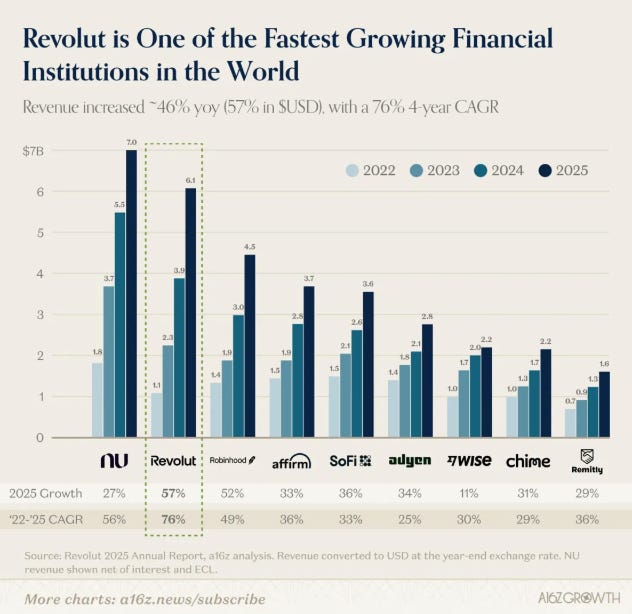
Within the small group of consumer fintech companies that have already surpassed that threshold, only Nubank is growing at a similar pace. Even then, the comparison favors Revolut, which operates in a mature European banking market, unlike Nu, which is expanding across emerging markets that previously had lower levels of banking penetration. Profit before tax increased 57% to £1.7 billion, with a 38% margin, while ROE reached 35%, even though the company was operating with less capital than the minimum required by regulators.
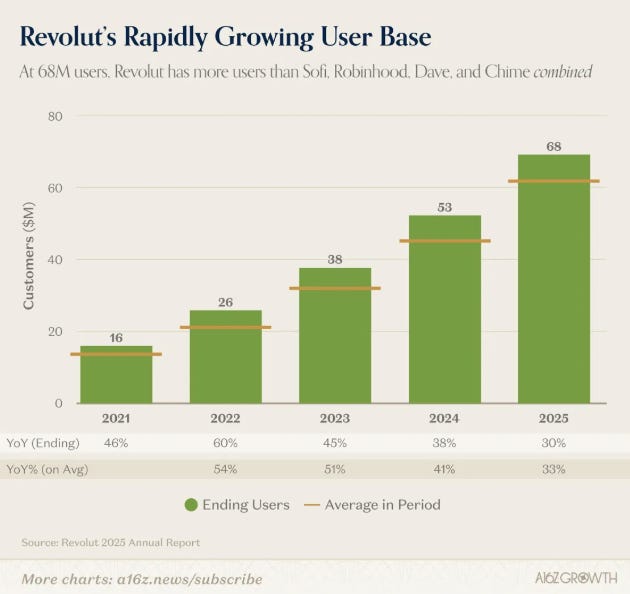
This growth is no longer supported by a single product. Revolut currently reports six revenue streams: interest income, card payments, wealth, foreign exchange, subscriptions, and other revenue. None accounts for more than 22% of total revenue, and eleven different products already generate more than £100 million in standalone revenue. Fees and commissions represent 76% of revenue, compared with 22% from interest income. This is the reverse of a traditional bank, which typically generates 70% or more of its revenue from interest on lending. This revenue mix allows Revolut to maintain a high ROE even during a cycle of falling interest rates, something that would normally hurt a conventional bank. On the customer side, its user base reached 68 million, more than SoFi, Robinhood, Dave, and Chime combined. Around 65% of new customers joined organically or through referrals, without paid customer acquisition costs.
One particularly interesting aspect of Revolut, and one that helps illustrate how much potential the fintech still has, is that its lending business is still maturing. Revolut’s loan-to-deposit ratio ended 2025 at approximately 6%, compared with 70% to 90% for established banks, while its loan portfolio still doubled during the year. The number of users treating Revolut as their primary account increased by 45%, almost twice the overall rate of user growth. This matters because primary-account users spend and save approximately twice as much as secondary users transact through the platform.
As a reference point for its potential ceiling, Barclays’ consumer and business banking operation in the United Kingdom generates an ARPU of approximately £435 per customer, compared with the £72 currently reported by Revolut. The application for a banking charter in the United States is another interesting part of this maturation process. It shows that the company is repeating the same playbook that already worked in Europe: entering through foreign exchange services, expanding into a full-service bank, becoming the customer’s primary account, and monetizing the relationship through credit.

Visa cuts 7% of its workforce as payments companies reallocate capital
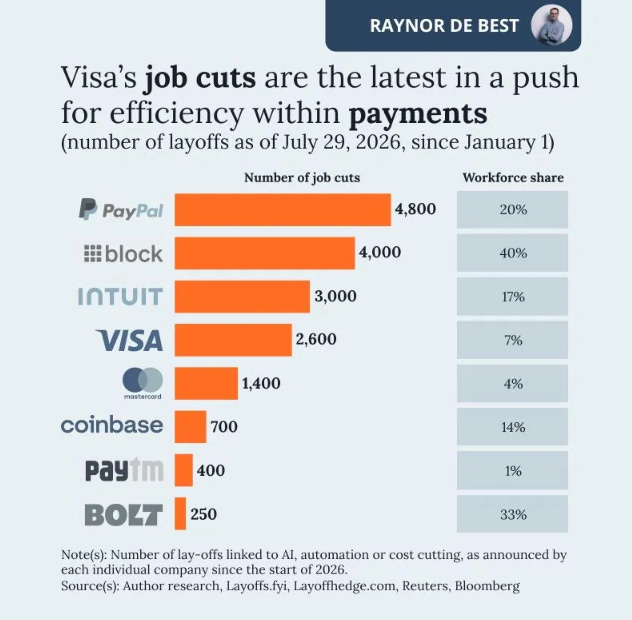
Visa announced that it is cutting 2,600 jobs, representing 7% of its global workforce of approximately 34,100 employees. The announcement came six months after Mastercard cut 4% of its own workforce for the same stated reason: improving efficiency.
The move adds Visa to a list that already includes PayPal, with 4,800 job cuts representing 20% of its workforce, Block, with 4,000 cuts representing 40%, Intuit, with 3,000 representing 17%, Coinbase, with 700 representing 14%, Paytm, with 400 representing 1%, and Bolt, with 250 representing 33%, since January of this year. These figures are based on data compiled from Layoffs.fyi, Layoffhedge.com, Reuters, and Bloomberg. What separates this cycle from a traditional cost-cutting crisis is that both Visa and Mastercard reported strong financial results during the same quarter in which they announced the layoffs. This suggests capital reallocation rather than cash preservation.
According to an internal memo reported by Bloomberg, CEO Ryan McInerney said the decision would free up capital to reinvest in the company’s highest-potential areas. He cited consumer payments, commercial money movement, and value-added services, a category that includes stablecoins, cross-border payments, and B2B payments. At Mastercard, CFO Sachin Mehra attributed the decision to an internal strategic review. The affected areas at both companies are primarily technology and product. This reinforces the view that these cuts are not simply broad operational reductions. They represent a reallocation of headcount away from maintaining card infrastructure and toward building rails capable of supporting payment initiation by AI agents.
The question for anyone operating a checkout experience today is whether the infrastructure was designed only for human buyers or whether it can also support an agent initiating a purchase on someone’s behalf. In Brazil, this transition may happen with less friction than in card-based markets because Pix and Open Finance already provide the necessary programmable rails. One interesting recent example was O Iniciador’s launch of the first Open Finance payments MCP for AI models. When two networks the size of Visa and Mastercard decide to reduce product teams to fund agentic commerce during the same quarter in which they report record profits, it suggests that the market already views this volume as relevant in the near term, rather than as a long-term research bet.
Until the next!
Walter Pereira
If you know anyone who would like to receive this e-mail or who is fascinated by the possibilities of financial innovation, I’d really appreciate you forwarding this email their way!
Disclaimer: The opinions expressed here are solely the responsibility of the author, Walter Pereira, and do not necessarily reflect the views of the sponsors, partners, or clients of W Fintechs.